Understanding your body composition is one of the most important steps you can take toward better health. If you’ve been wondering how to estimate BMI, you’re in the right place. This comprehensive guide walks you through everything — from the basic BMI formula and step-by-step calculations to the latest 2025–2026 medical guidelines that are revolutionizing how doctors look at body weight and obesity.
1. What Is BMI?
BMI stands for Body Mass Index. 21It is a measure of body fat based on height and weight that applies to adult men and women. 25BMI is a value derived from the mass (weight) and height of a person. The BMI is defined as the body mass divided by the square of the body height, and is expressed in units of kg/m², resulting from mass in kilograms (kg) and height in metres (m).
The concept has a long history. 23BMI was devised in the 1830s by Lambert Adolphe Jacques Quetelet (1796–1874), a Belgian mathematician, sociologist, statistician, and astronomer. Despite being nearly 200 years old, BMI remains one of the most commonly used health screening tools worldwide.
25 The BMI has been used by the WHO as the standard for recording obesity statistics since the early 1980s. While it has its limitations (which we will cover in detail below), learning **how to estimate BMI** is a powerful first step toward understanding your health profile.
2. Why Should You Learn How to Estimate BMI?
There are several compelling reasons to know how to estimate BMI:
- Quick Health Screening: 26BMI is a quick, accessible, and low-cost measure, based on your weight and height, used to determine if you are in a healthy — or unhealthy — weight range.
- Disease Risk Assessment: 29BMI is often used to help tell if your weight might put you at risk for health problems such as heart disease, diabetes, and cancer.
- Clinical Standard: 5The ADA recommends that clinicians screen for overweight and obesity using BMI annually.
- Accessibility: 28BMI offers certain benefits that make it useful. It is easy to calculate, and it does not require special equipment. This makes it easy to assess during an office visit, moving directly to diagnosis and treatment recommendations.
- Self-Monitoring: 26Anyone can go online and find a free BMI calculator, plug in their weight and height, and get back a number.
Knowing how to estimate BMI empowers you to have informed conversations with your healthcare provider and track your progress over time.
3. The BMI Formula Explained (Metric & Imperial)
Learning how to estimate BMI starts with understanding two simple formulas.
Metric Formula
BMI = Weight (kg) ÷ Height (m)²
20 BMI is a person’s weight (in kilograms) divided by their height (in meters) squared.
Example:
- Weight: 75 kg
- Height: 1.75 m
- BMI = 75 ÷ (1.75 × 1.75) = 75 ÷ 3.0625 = 24.49
Imperial Formula (Pounds & Inches)
BMI = [Weight (lbs) ÷ Height (in)²] × 703
26 BMI is your weight in pounds (or kilograms) divided by the square of your height in inches (or meters). When calculating your BMI using pounds and inches, you will need to multiply your weight by 703, a conversion factor.
Example:
- Weight: 200 lbs
- Height: 5’10” (70 inches)
- BMI = (200 ÷ 4,900) × 703 = 0.04082 × 703 = 28.69
26 If your calculator does not have a square function, simply divide weight by height twice.
Pro Tip: For the most accurate results when learning how to estimate BMI, weigh yourself in the morning before eating, wearing minimal clothing.
4. Step-by-Step: How to Estimate BMI at Home
Follow these simple steps to estimate your BMI without any special tools:
Step 1: Measure Your Weight
Use a digital scale for accuracy. Record your weight in either kilograms or pounds.
Step 2: Measure Your Height
Stand against a wall without shoes. Use a tape measure or stadiometer. Record your height in meters (or feet and inches).
Step 3: Apply the Formula
- Metric: Divide your weight in kilograms by the square of your height in meters.
- Imperial: Divide your weight in pounds by the square of your height in inches, then multiply by 703.
Step 4: Check Your Category
Compare your result against the standard BMI categories (listed below).
Step 5: Consult a Professional
21 Your BMI is just one piece of the puzzle. It’s based on height and weight but doesn’t take into account your muscle mass, bone density, or body composition. Your healthcare provider will consider whether your BMI is too high or too low for you.
5. BMI Categories and What They Mean
Once you learn how to estimate BMI, you need to understand what the number means. 25Major adult BMI classifications are underweight (under 18.5 kg/m²), normal weight (18.5 to 24.9), overweight (25 to 29.9), and obese (30 or more).
Here is the standard WHO classification:
| BMI Range | Category | Health Risk Level |
|---|---|---|
| Below 18.5 | Underweight | Moderate (malnutrition risk) |
| 18.5 – 24.9 | Normal Weight | Low |
| 25.0 – 29.9 | Overweight | Increased |
| 30.0 – 34.9 | Obesity Class I | High |
| 35.0 – 39.9 | Obesity Class II | Very High |
| 40.0 and above | Obesity Class III (Severe) | Extremely High |
8 For the past 5 decades, obesity has been primarily defined by BMI, calculated as weight in kilograms divided by height in meters squared. In this classification, obesity is categorized as a BMI of 30 or higher, with the following subcategories: class I (BMI of 30–34.9), class II (BMI of 35–39.9), and class III (BMI of ≥40).
Understanding these categories after you estimate your BMI gives you actionable insight into potential health risks.
6. How to Estimate BMI for Children and Teens
Estimating BMI for younger populations works differently. 25BMI is used differently for people aged 2 to 20. It is calculated in the same way as for adults but then compared to typical values for other children or youth of the same age. Instead of comparison against fixed thresholds for underweight and overweight, the BMI is compared against the percentiles for children of the same sex and age.
25 A BMI that is less than the 5th percentile is considered underweight and above the 95th percentile is considered obese. Children with a BMI between the 85th and 95th percentile are considered to be overweight. 29 An easy way to determine your child’s BMI percentile is to use the CDC’s online BMI percentile calculator.
Why This Matters in 2026
Childhood obesity is a growing global crisis. 17In 2025, an estimated 419 million children and adolescents aged 5–19 years were living with overweight and obesity. This is predicted to rise to 507 million by 2040. 12Worldwide, more than one in five (20.7%) in the 5–19 age group are living with obesity or are overweight, an increase of 14.6% since 2010.
Tracking your child’s BMI percentile is one of the earliest interventions parents can make.
7. BMI Chart: Quick Reference Table
Here’s a quick-reference chart to help you estimate BMI without a calculator:
| Height | Weight for BMI 18.5 | Weight for BMI 25 | Weight for BMI 30 |
|---|---|---|---|
| 5’0″ (152 cm) | 95 lbs (43 kg) | 128 lbs (58 kg) | 153 lbs (69 kg) |
| 5’4″ (163 cm) | 108 lbs (49 kg) | 145 lbs (66 kg) | 174 lbs (79 kg) |
| 5’8″ (173 cm) | 122 lbs (55 kg) | 164 lbs (74 kg) | 197 lbs (89 kg) |
| 5’10” (178 cm) | 129 lbs (59 kg) | 174 lbs (79 kg) | 209 lbs (95 kg) |
| 6’0″ (183 cm) | 137 lbs (62 kg) | 184 lbs (84 kg) | 221 lbs (100 kg) |
| 6’2″ (188 cm) | 144 lbs (65 kg) | 194 lbs (88 kg) | 233 lbs (106 kg) |
29 Charts are another way to find your BMI. To use the table, find your height on the left side of the chart, then go across to the weight that is closest to yours.
8. 2025–2026 Updates: New Obesity Guidelines Beyond BMI
If you’re learning how to estimate BMI in 2026, it’s critical to understand the latest medical developments. The global medical community has introduced groundbreaking changes to how obesity is defined and diagnosed.
The Lancet Commission’s New Framework (January 2025)
3 The latest guidelines for measuring obesity — created by 58 medical experts, endorsed by 76 organizations, and published in the Lancet Diabetes & Endocrinology journal in early 2025 — are shifting away from solely using your BMI to measure obesity. 9 The new, evidence-based definition distinguishes “clinical obesity,” a chronic, systemic disease state directly caused by excess adiposity, from “preclinical obesity,” a condition of excess adiposity without current organ dysfunction or limitations in daily activities but with increased future health risk. 9 Given the limitations of BMI, the Commission uses other measurements of body size (waist circumference, waist-to-hip ratio, or waist-to-height ratio), in addition to BMI, to define obesity status.
BMI Alone Underestimates Obesity
1 A team of researchers from Beth Israel Deaconess Medical Center, Harvard University, Yale University, and Yale New Haven Health found that BMI alone may significantly underestimate how many U.S. adults have obesity. Using a new definition that includes waist-based measurements, the team found that more than 75% of adults may meet criteria for obesity compared to 40% when using BMI alone. 1 Nearly four in 10 adults with a “normal” BMI were found to have excess body fat when waist-based measures were also applied.
ADA Standards of Care 2026
7 Measurement of weight and height (to calculate BMI) and other anthropometric measurements should be performed at least annually to aid the diagnosis of obesity.
Global Obesity Statistics (2025–2026)
The urgency of understanding how to estimate BMI is underscored by alarming global trends:
- 11 As of 2025, approximately 16% of the global adult population is classified as obese (BMI ≥30), representing over 1 billion people worldwide. This has nearly tripled since 1975, with projections indicating that by 2035, over 50% of the global population may be overweight or obese if current trends continue.
- 11 The United States has an obesity rate of 42.4% as of 2025.
- 16 Current trends suggest that by 2030, 50% of adult men and women will be living with high BMI. In the same year, 17% of men and 22% of women will be living with obesity.
9. Limitations of BMI You Must Know
While learning how to estimate BMI is valuable, it’s equally important to understand where BMI falls short.
It Doesn’t Distinguish Fat from Muscle
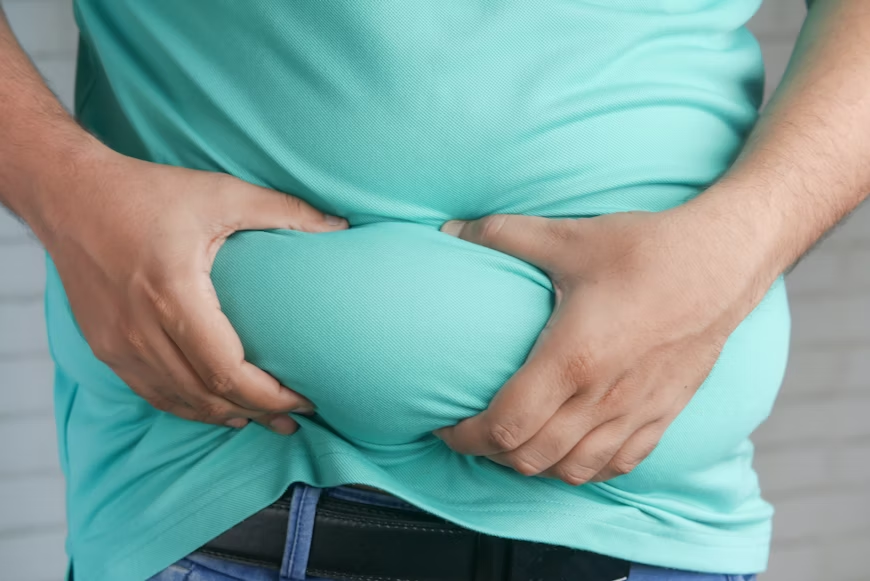
27 BMI is calculated using an individual’s height and weight — the formula is weight divided by height, squared. But the measure cannot distinguish between muscle and fat mass, only providing an indirect indication. 28 BMI does not account for body type. It does not measure muscle mass or bone density. For example, a person with high muscle mass, such as a football player, may be mistaken for having obesity, and a person with small bones but higher belly fat may be considered to have a healthy weight.
It Doesn’t Account for Fat Distribution
24 BMI is an anthropometric index that is commonly used in the medical setting and is a factor in assessing various disease risks, but it does not properly assess body fat percentage and muscle mass or distinguish abdominal fat from gluteofemoral fat, which is important because abdominal fat is associated with insulin resistance, metabolic disease, and cardiovascular complications.
Ethnic and Racial Variations
26 One issue is that BMI was developed based on the bodies of non-Hispanic white men; it may not provide consistently accurate results for people who fall into other categories of sex, ethnicity, and race.
Poor Sensitivity
30 BMI-defined obesity (≥30 kg/m²) was present in 21% of men and 31% of women, while body-fat-percentage-defined obesity was present in 50% and 62%, respectively. A BMI ≥30 had a high specificity (95% in men and 99% in women), but poor sensitivity (36% and 49%, respectively) to detect body-fat-defined obesity.
Age-Related Inaccuracy
29 Bodybuilders or other very muscular people can have a high BMI because of their muscle mass, even though they’re not necessarily in the overweight range for BMI. BMI can also underestimate body fat in people who have lost muscle mass, such as some older people.
Despite these limitations, BMI remains a useful starting point. As one expert put it: 26“The problem is not BMI itself, but the tendency to use it as a single focus.”
10. Better Alternatives to Complement BMI in 2026
In light of the 2025–2026 guideline updates, health experts now recommend combining BMI with additional measurements:
Waist Circumference (WC)
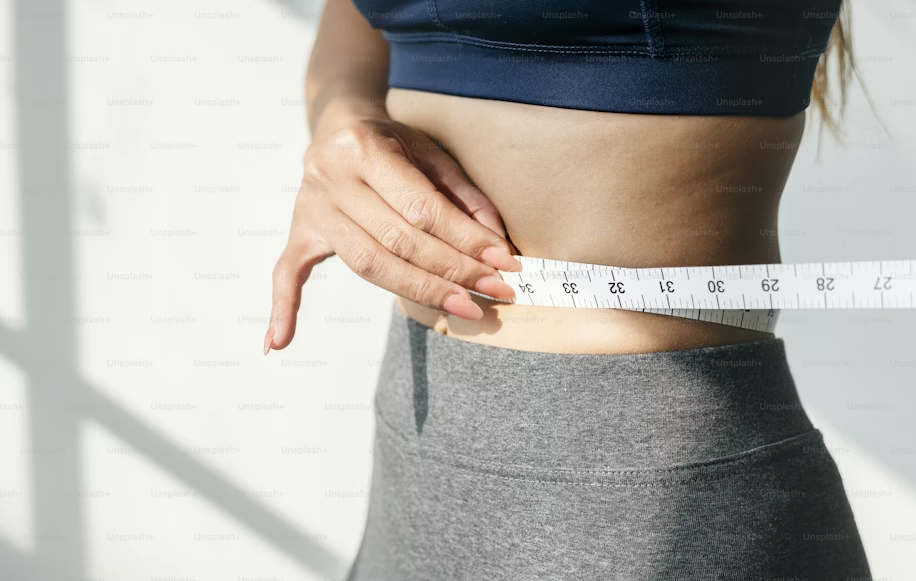
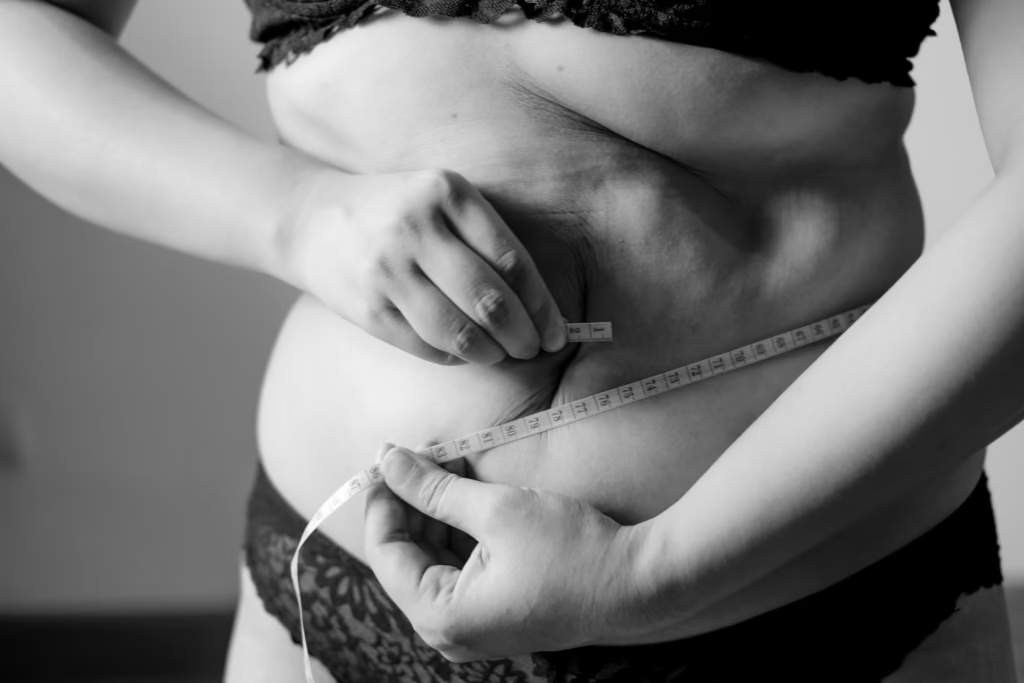
26 A person with more belly fat would have a greater waist circumference, which is associated with a higher risk of heart disease, diabetes, and liver problems. The risk for health problems from being overweight increases with a waist circumference of more than 40 inches in men and 35 inches in women, even if their BMI is below the “overweight” range.
Waist-to-Hip Ratio (WHR)
24 In a meta-analysis of 38 cross-sectional and two cohort studies examining the discriminatory capacity of BMI, WC, and WHR for CVD in a total of 137,256 adults, indices of abdominal obesity, especially WHR, were shown to better predict CVD occurrence.
Waist-to-Height Ratio (WHtR)
24 In one of the first studies involving more than 300,000 adults of various ethnic groups, WHtR had significantly greater discriminatory power compared with BMI. WHtR also showed to be significantly better than WC in DM, hypertension, CVD, and all outcomes.
A simple rule of thumb: keep your waist circumference less than half your height.
Bioelectrical Impedance Analysis (BIA)
27 A direct measure of body fat using a relatively inexpensive device that notes the resistance of body tissue to a small electrical current is far more accurate. This method, bioelectrical impedance analysis, is increasingly found in medical practices. 27 Devices that measure bioelectrical impedance are increasingly affordable, with many models under $300.
Body Fat Percentage
28 Alternative metrics for assessing body weight can be used in combination with other health data (including BMI). Body fat percentage recommendations are tailored according to sex and age. The simplest way to measure it is with skin calipers.
The 2026 recommendation: Estimate your BMI as a baseline, then supplement it with at least one waist-based measurement and ideally a body fat assessment for a more complete health picture.
11. How to Use Your BMI Results Wisely
Once you’ve learned how to estimate BMI and calculated your number, here’s how to use it effectively:
If Your BMI Is Below 18.5 (Underweight)
- Consult a healthcare provider to rule out nutritional deficiencies or eating disorders.
- Focus on nutrient-dense foods and strength training.
If Your BMI Is 18.5–24.9 (Normal Weight)
- Continue maintaining a balanced diet and regular physical activity.
- Remember: 1Nearly four in 10 adults with a “normal” BMI were found to have excess body fat when waist-based measures were also applied. Consider checking your waist circumference too.
If Your BMI Is 25–29.9 (Overweight)
- Evaluate your waist circumference and body composition.
- Consider lifestyle modifications including diet improvement and increased physical activity.
- 7 A person-centered communication style that uses inclusive and nonjudgmental language should be used to optimize health outcomes. Approach weight management without shame.
If Your BMI Is 30+ (Obese)
- Seek guidance from a healthcare professional.
- 5 The FDA has approved several medications for obesity as adjuncts to a reduced-calorie eating pattern and increased physical activity in individuals with BMI ≥30 kg/m² or ≥27 kg/m² with one or more obesity-associated comorbid conditions.
- Discuss the full range of treatment options with your doctor, including lifestyle, medication, and surgical interventions.
12. Frequently Asked Questions (FAQs)
How do I estimate my BMI without a calculator?
Use a BMI chart. 29Charts are another way to find your BMI. To use the table, find your height on the left side of the chart, then go across to the weight that is closest to yours.
Is BMI the same for men and women?
29 In adults, BMI is calculated the same way for both men and women. However, the interpretation may vary because men and women have different body compositions. Women typically carry more body fat than men at the same BMI.
How often should I check my BMI?
7 Measurement of weight and height (to calculate BMI) and other anthropometric measurements should be performed at least annually to aid the diagnosis of obesity.
Is BMI accurate for athletes?
No. 29The BMI may not be accurate for people with greater muscle mass (such as athletes) or in older people and others who have lost muscle mass. Athletes should use body fat percentage or other methods instead.
Has the BMI system changed in 2025–2026?
Yes, significantly. 4The Lancet Commission has introduced two novel diagnostic categories of obesity: clinical obesity and pre-clinical obesity, which delineate if and how an individual’s excess body fat affects their organ health and daily functioning. 4This is a significant shift from the current standard of care, which primarily relies on BMI to diagnose obesity.
What is the best way to estimate BMI in 2026?
Calculate your BMI using the standard formula, then supplement it with waist circumference and waist-to-height ratio. 3These new measurements offer a more accurate picture of your health beyond the limitations of BMI. They help target the root causes of obesity-related health issues and allow for more personalized care.
Can I estimate BMI using an online tool?
Absolutely. 26The Centers for Disease Control and Prevention (CDC) provides calculators that will perform this math for different age groups: There is one for adults ages 20 and older and another for children and teens ages 2 through 19.
What is a good BMI number?
23 You are of normal weight if your BMI is between 18.5 and 25, overweight if it is between 25 and 30. Anybody with a BMI of 30 or more has obesity.
Final Thoughts: How to Estimate BMI the Right Way in 2026
Learning how to estimate BMI is a simple yet powerful health skill. The formula is straightforward — weight divided by height squared — and the calculation takes less than a minute. However, the medical landscape in 2025–2026 has evolved far beyond relying on BMI as a standalone measure.
6 Obesity is a chronic, relapsing, and progressive disease requiring long-term, interprofessional treatment strategies to improve health outcomes. With over 40% of US adults and nearly 20% of children affected, obesity remains a significant public health concern.
The key takeaways for 2026:
- Start with BMI — it’s free, fast, and universally understood.
- Add waist measurements — waist circumference and waist-to-height ratio provide critical additional data.
- Consider body fat analysis — especially if you’re athletic, elderly, or have results that seem inconsistent.
- Follow the new guidelines — the Lancet Commission and ADA 2026 Standards both recommend looking beyond BMI alone.
- Consult a professional — your BMI is a conversation starter, not a diagnosis.
By combining BMI estimation with modern measurement tools and the latest clinical guidelines, you can gain the most accurate and actionable picture of your health in 2026.
Disclaimer: This article is for informational purposes only and does not constitute medical advice. Always consult a qualified healthcare professional before making decisions about your health.

A health content specialist with hands-on experience in BMI Calculator Pro tools, focused on accurate body measurements, BMI insights, and easy-to-understand health guidance for everyday users.

Pingback: Reverse BMI Calculator For Height: The Complete 2026 Guide To Finding Your Ideal Stature - BMI Calculator Pro