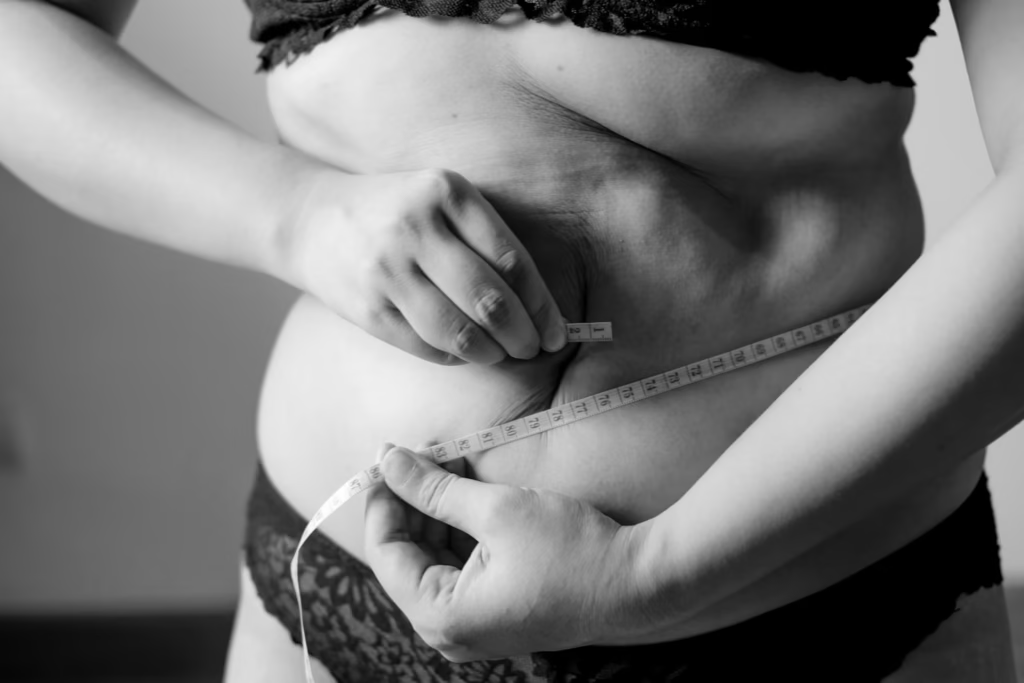
Introduction: How to Calculate BMI Without a Calculator
Learning how to calculate BMI without a calculator is a genuinely practical health skill that every adult should have in their personal wellness toolkit. While digital calculators, smartphone apps, and online BMI tools are widely available and convenient, there are countless situations where these resources are simply not accessible, such as a doctor’s waiting room, a fitness class, a health education setting, or simply a moment of personal curiosity without a device at hand.
More importantly, understanding how to calculate BMI without a calculator gives you a deeper appreciation of what the BMI formula actually means and how it works. When you can perform the calculation mentally or on paper, you truly understand the relationship between your height and weight in a way that pressing a button on a digital tool never quite achieves.
This comprehensive guide teaches you multiple practical methods for calculating BMI without a calculator, from simple mental arithmetic shortcuts and estimation techniques to reference tables and rounding strategies that make the math manageable for anyone, regardless of their mathematical background. By the end of this guide, you will be able to estimate your BMI accurately in almost any situation using nothing more than basic arithmetic and a clear understanding of the formula.
Understanding the BMI Formula Before Calculating Without a Calculator
Before exploring how to calculate BMI without a calculator, it is essential to have the formula clearly understood. The standard metric BMI formula is:
BMI = Weight (kilograms) divided by Height (meters) squared
Breaking this down into its component parts:
- Weight must be expressed in kilograms
- Height must be expressed in meters (convert from centimeters by dividing by 100)
- Height squared means height in meters multiplied by itself
- The division of weight by height squared produces the BMI value
The imperial formula used primarily in the United States is:
BMI = Weight (pounds) divided by Height (inches) squared, multiplied by 703
For manual calculation without a calculator, the metric formula is significantly easier to work with because it avoids the additional multiplication by the conversion factor of 703. This guide focuses primarily on the metric system for this reason.
Method 1: Pure Mental Arithmetic Using Simple Numbers
The most direct answer to how to calculate BMI without a calculator is performing the arithmetic mentally using a structured approach. This works most easily when your measurements are round or near-round numbers.
How It Works:
The calculation involves three operations:
- Squaring your height in meters
- Dividing your weight by that squared value
- Interpreting the resulting number
Mental Math Strategy for Squaring Height:
Most adults have heights between 1.50 meters and 2.00 meters. Learning the squares of common heights in this range makes the first step straightforward.
Common Height Squares (Memorize These):
| Height (m) | Height Squared (m squared) |
|---|---|
| 1.50 m | 2.25 |
| 1.55 m | 2.40 |
| 1.60 m | 2.56 |
| 1.65 m | 2.72 |
| 1.70 m | 2.89 |
| 1.75 m | 3.06 |
| 1.80 m | 3.24 |
| 1.85 m | 3.42 |
| 1.90 m | 3.61 |
| 1.95 m | 3.80 |
| 2.00 m | 4.00 |
By memorizing or referencing this table, you eliminate the need to calculate height squared manually every time.
Mental Division Strategy:
Once you have the height squared value, divide your weight by it. For mental division, the key is to work with approximations and round numbers.
Worked Example Using Mental Arithmetic:
Person: Adult male
Weight: 80 kg (a round, easy number)
Height: 1.75 m (height squared from table = 3.06)
Mental calculation:
80 divided by 3.06 is approximately 80 divided by 3 = approximately 26.7
Since we divided by 3 instead of 3.06, the true answer is slightly lower.
More precisely: 80 divided by 3.06 = approximately 26.1
Classification: Overweight (25.0 to 29.9)
Method 2: The Simplified Estimation Technique
For those asking how to calculate BMI without a calculator with minimal mathematical effort, the simplified estimation technique uses strategic rounding and a two-step mental process that produces a reliable approximate result.
The Two-Step Estimation Method:
Step 1: Round your height squared to the nearest convenient decimal.
Step 2: Divide your weight by that rounded value using simple mental division.
How to Make Division Easier Without a Calculator:
When dividing weight by height squared mentally, convert the division into a multiplication problem using reciprocals.
For example:
- Dividing by 3 is the same as multiplying by 0.33
- Dividing by 2.5 is the same as multiplying by 0.4
- Dividing by 2 is the same as multiplying by 0.5
- Dividing by 4 is the same as multiplying by 0.25
Worked Example Using Estimation:
Weight: 65 kg
Height: 1.65 m (height squared approximately = 2.72, round to 2.7)
Estimation:
65 divided by 2.7
Think of it as: 65 divided by 3 = 21.7, then adjust slightly upward because 2.7 is less than 3.
Approximately 24.1
True calculated value: 65 divided by 2.7225 = 23.87
Estimation accuracy: Within 0.3 BMI units — more than sufficient for category determination.
Method 3: Using Pre-Calculated BMI Reference Tables
One of the most practical answers to how to calculate BMI without a calculator is simply using a well-constructed pre-calculated reference table. These tables display BMI values for a wide range of height and weight combinations, allowing you to find your approximate BMI by locating the intersection of your height row and weight column.
Sample BMI Reference Table (Metric):
| Weight (kg) | 1.60 m | 1.65 m | 1.70 m | 1.75 m | 1.80 m | 1.85 m |
|---|---|---|---|---|---|---|
| 50 kg | 19.5 | 18.4 | 17.3 | 16.3 | 15.4 | 14.6 |
| 55 kg | 21.5 | 20.2 | 19.0 | 18.0 | 17.0 | 16.1 |
| 60 kg | 23.4 | 22.0 | 20.8 | 19.6 | 18.5 | 17.5 |
| 65 kg | 25.4 | 23.9 | 22.5 | 21.2 | 20.1 | 19.0 |
| 70 kg | 27.3 | 25.7 | 24.2 | 22.9 | 21.6 | 20.5 |
| 75 kg | 29.3 | 27.5 | 26.0 | 24.5 | 23.1 | 21.9 |
| 80 kg | 31.3 | 29.4 | 27.7 | 26.1 | 24.7 | 23.4 |
| 85 kg | 33.2 | 31.2 | 29.4 | 27.8 | 26.2 | 24.8 |
| 90 kg | 35.2 | 33.1 | 31.1 | 29.4 | 27.8 | 26.3 |
| 95 kg | 37.1 | 34.9 | 32.9 | 31.0 | 29.3 | 27.8 |
| 100 kg | 39.1 | 36.7 | 34.6 | 32.7 | 30.9 | 29.2 |
How to Use This Table:
Find your height in the column headers across the top. Find your weight in the row labels down the left side. The number at the intersection of your height column and weight row is your approximate BMI.
Example: A person weighing 75 kg and standing 1.75 m tall has a BMI of approximately 24.5, which is normal weight.
If your exact height or weight is not listed, find the nearest values and estimate between them.
Method 4: The Paper and Pencil Long Division Method
For those who want to know how to calculate BMI without a calculator with complete mathematical precision, performing the calculation on paper using long division is a reliable and accurate approach.
Step-by-Step Paper Calculation:
Given:
Weight = 73 kg
Height = 1.72 m
Step 1: Calculate height squared on paper.
1.72 multiplied by 1.72:
Working out 1.72 multiplied by 1.72 on paper:
- 172 multiplied by 172 = 29,584
- Adjust decimal: 1.72 has two decimal places, so 1.72 squared = 2.9584
Step 2: Perform long division.
73 divided by 2.9584
Simplify by working with 73 divided by approximately 2.96:
- 2.96 multiplied by 20 = 59.2
- 73 minus 59.2 = 13.8
- 2.96 multiplied by 4 = 11.84
- 13.8 minus 11.84 = 1.96
- 2.96 multiplied by 0.6 = 1.776
Approximate answer: 24.6
True calculated value: 73 divided by 2.9584 = 24.68
Paper calculation accuracy: Within 0.1 BMI units, highly accurate.
Method 5: The Benchmark Comparison Method
A uniquely practical approach to understanding how to calculate BMI without a calculator is the benchmark comparison method. This technique uses known BMI boundary weights for your specific height to quickly determine which BMI category you fall into without performing the full calculation.
How to Determine Boundary Weights for Your Height:
The boundary weights represent the weight at which you cross from one BMI category to another at your specific height.
Boundary weight formulas:
- Underweight boundary (BMI 18.5): 18.5 multiplied by height squared
- Normal weight boundary (BMI 25.0): 25.0 multiplied by height squared
- Overweight boundary (BMI 30.0): 30.0 multiplied by height squared
Worked Example:
Height: 1.70 m
Height squared: 1.70 multiplied by 1.70 = 2.89
Boundary weights:
- Underweight boundary: 18.5 multiplied by 2.89 = 53.5 kg
- Normal-overweight boundary: 25.0 multiplied by 2.89 = 72.3 kg
- Overweight-obese boundary: 30.0 multiplied by 2.89 = 86.7 kg
Interpretation for a person 1.70 m tall:
- Below 53.5 kg = Underweight
- 53.5 kg to 72.3 kg = Normal Weight
- 72.3 kg to 86.7 kg = Overweight
- Above 86.7 kg = Obese
Now compare your actual weight against these boundaries to instantly determine your BMI category without calculating your actual BMI score.
Pre-Calculated Boundary Weight Table:
| Height | Underweight | Normal Weight Range | Overweight | Obese |
|---|---|---|---|---|
| 1.55 m | Below 44.4 kg | 44.4 to 60.0 kg | 60.0 to 72.0 kg | Above 72.0 kg |
| 1.60 m | Below 47.4 kg | 47.4 to 64.0 kg | 64.0 to 76.8 kg | Above 76.8 kg |
| 1.65 m | Below 50.3 kg | 50.3 to 68.1 kg | 68.1 to 81.7 kg | Above 81.7 kg |
| 1.70 m | Below 53.5 kg | 53.5 to 72.3 kg | 72.3 to 86.7 kg | Above 86.7 kg |
| 1.75 m | Below 56.7 kg | 56.7 to 76.6 kg | 76.6 to 91.9 kg | Above 91.9 kg |
| 1.80 m | Below 59.9 kg | 59.9 to 81.0 kg | 81.0 to 97.2 kg | Above 97.2 kg |
| 1.85 m | Below 63.3 kg | 63.3 to 85.6 kg | 85.6 to 102.7 kg | Above 102.7 kg |
This table is perhaps the single most useful tool for anyone learning how to calculate BMI without a calculator in everyday situations.
Tips for Making Manual BMI Calculation Easier
Mastering how to calculate BMI without a calculator becomes significantly easier with the following practical tips:
Tip 1: Memorize Your Height Squared
Since your height changes very infrequently as an adult, memorizing your personal height squared value means you only ever need to perform one division when calculating BMI — weight divided by your memorized height squared value.
Tip 2: Use Round Number Approximations
Round your weight to the nearest five kilograms for estimation purposes. The resulting BMI approximation will be close enough to determine your BMI category in almost all cases.
Tip 3: Work With Fractions When Possible
Some height-squared values simplify nicely to fractions that are easier to divide mentally. For example, height squared for 1.80 m is 3.24, which is close to 3.25, which equals 13 divided by 4, making division somewhat more manageable mentally.
Tip 4: Use the Boundary Weight Method for Quick Category Determination
If you only need to know your BMI category rather than your precise score, the boundary weight comparison method described in Method 5 is the fastest and most practical approach for everyday use.
Tip 5: Practice the Calculation Regularly
Like any mathematical skill, manual BMI calculation becomes faster and more accurate with practice. Calculating BMI for different hypothetical weights and heights helps build fluency with the formula and makes the process feel natural.
Valuable Update for 2026: Manual BMI Skills in a Digital Health World
Understanding how to calculate BMI without a calculator remains a relevant and valuable skill in 2026, even as digital health technology advances at an extraordinary pace. Here is why this manual knowledge matters more than ever and what new developments are shaping the landscape.
Health Literacy as a Global Priority in 2026
The World Health Organization and national health authorities worldwide have elevated health literacy to the status of a critical public health priority in 2026. The ability to understand, calculate, and interpret basic health measurements, including BMI, without relying entirely on digital tools is now recognized as an important component of health literacy that empowers individuals to manage their own health more independently and effectively.
Research published in leading public health journals in 2025 demonstrates that individuals with higher health numeracy have the ability to understand and use numerical health information, make better health decisions, engage more productively with healthcare providers, and achieve better long-term health outcomes. Teaching manual BMI calculation is increasingly seen as a practical component of health numeracy education.
Digital Divide and the Continuing Importance of Manual Methods
Despite the proliferation of digital health tools, a significant global digital divide persists in 2026. Billions of people worldwide still lack reliable access to smartphones, internet connectivity, or digital health platforms, particularly in low and middle-income countries, where the burden of obesity-related chronic disease is rising most rapidly.
In these contexts, the ability to calculate BMI manually using nothing more than basic measurements and arithmetic remains an essential public health tool. Community health workers, rural health educators, and frontline healthcare providers in resource-limited settings rely heavily on manual BMI calculation methods and pre-printed reference tables of exactly the type described in this guide.
Integration of Mental Math Health Skills in Education
Several countries, including Finland, Singapore, Australia, and Canada, began in 2025 and 2026 to integrate practical health mathematics — including manual BMI calculation into school health education curricula. Students learn both the mathematical skills and the health context simultaneously, building health numeracy from an early age and ensuring that the next generation can engage meaningfully with their own health data regardless of the digital tools available to them.
Printed BMI Reference Tools in Community Health Settings
Community health programs operating in 2026 across Africa, South Asia, Southeast Asia, and Latin America are distributing printed BMI reference cards and boundary weight tables similar to the tables included in this guide as part of broader community health education initiatives. These printed tools, which require no electricity, internet connection, or digital literacy, are enabling community health workers to perform BMI screenings for millions of people who would otherwise have no access to weight status assessment.
Cognitive Benefits of Manual Calculation
Emerging research in cognitive health published in 2025 and continuing in 2026 suggests that regular engagement with mental arithmetic provides meaningful cognitive benefits, including improved working memory, attention, and numerical processing speed. Teaching and practicing manual BMI calculation, therefore, offers a dual benefit, developing an important health monitoring skill while simultaneously exercising cognitive functions associated with healthy brain aging.
Emergency and Disaster Health Response Applications
Emergency health response teams operating in disaster and conflict zones where electronic infrastructure has been destroyed or is unavailable rely entirely on manual health assessment methods in 2026. Field medics, emergency nutritional assessment teams, and disaster response health workers use manual BMI calculation alongside other physical assessment techniques to rapidly identify individuals at nutritional risk in populations affected by natural disasters, conflict, and humanitarian crises.
Conclusion: How to Calculate BMI Without a Calculator
Mastering how to calculate BMI without a calculator is a practical, empowering, and genuinely useful health skill that serves you in countless real-world situations. From the simple mental arithmetic approaches and estimation techniques described in this guide to the practical boundary weight comparison tables and pre-calculated reference charts, you now have multiple reliable methods for determining your BMI category without any electronic assistance.
The most immediately practical tools from this guide are the height-specific boundary weight tables, which allow you to determine your BMI category with a single weight comparison, and the pre-calculated BMI reference table, which allows you to read your approximate BMI directly from your height and weight measurements.
Practice these methods regularly, memorize your personal height squared value, and keep a boundary weight reference table available for quick consultations. Combined with a thorough understanding of what your BMI result means and how it fits into a broader picture of personal health, this manual calculation knowledge gives you a meaningful and lasting addition to your personal health literacy in 2026 and beyond.
Medical Disclaimer: This article is provided for educational and informational purposes only. BMI is a screening tool and does not constitute a medical diagnosis. Always consult a qualified healthcare professional for personalized health assessment and medical recommendations.

A health content specialist with hands-on experience in BMI Calculator Pro tools, focused on accurate body measurements, BMI insights, and easy-to-understand health guidance for everyday users.