What Is BMI and Why Use Kilograms?
Body Mass Index (BMI) is the international standard for assessing healthy body weight relative to height. Using kilograms (kg) and meters provides the most accurate metric calculation, adopted by the World Health Organization (WHO) and medical institutions globally
.
The metric formula is straightforward:
- BMI = weight (kg) ÷ height² (m²)
For example, if you weigh 70 kg and stand 1.75 meters tall:
- 70 ÷ (1.75 × 1.75) = 22.9 BMI (Healthy weight range)
Quick Fact: In 2022, 43% of adults worldwide were overweight, with obesity rates doubling since 1990
. Understanding your BMI category helps identify potential health risks early.
Official BMI Chart KG Categories (WHO & CDC Standards 2026)
The following BMI chart kg classifications apply to adults aged 20 and older, based on current WHO and CDC guidelines
:Table
Copy
| BMI Category | BMI Range (kg/m²) | Health Risk Level |
|---|---|---|
| Severe Thinness | Less than 16 | Very High |
| Moderate Thinness | 16.0 – 16.9 | High |
| Mild Thinness | 17.0 – 18.4 | Moderate |
| Healthy Weight | 18.5 – 24.9 | Low (Optimal) |
| Overweight | 25.0 – 29.9 | Increased |
| Obesity Class I | 30.0 – 34.9 | High |
| Obesity Class II | 35.0 – 39.9 | Very High |
| Obesity Class III | 40.0 and above | Extremely High |
Key Differences by Ethnicity
Recent 2024-2025 guidelines highlight important variations:
- Asian, Chinese, Middle Eastern, Black African, and African-Caribbean populations should use lower thresholds: overweight starts at BMI 23, obesity at 27.5
- These populations face higher health risks at lower BMI values due to differences in body composition and fat distribution
Detailed BMI Chart KG by Height (Quick Reference)
Use this comprehensive chart to find your ideal weight range without calculation:Table
Copy
| Height | Healthy Weight (kg) BMI 18.5-24.9 | Overweight (kg) BMI 25-29.9 | Obese (kg) BMI 30+ |
|---|---|---|---|
| 150 cm (4’11”) | 41.6 – 56.0 | 56.3 – 67.5 | 67.5+ |
| 155 cm (5’1″) | 44.4 – 59.8 | 60.1 – 72.0 | 72.0+ |
| 160 cm (5’3″) | 47.4 – 63.7 | 64.0 – 76.8 | 76.8+ |
| 165 cm (5’5″) | 50.4 – 67.8 | 68.1 – 81.6 | 81.6+ |
| 170 cm (5’7″) | 53.5 – 72.0 | 72.3 – 86.7 | 86.7+ |
| 175 cm (5’9″) | 56.7 – 76.3 | 76.6 – 91.9 | 91.9+ |
| 180 cm (5’11”) | 60.0 – 80.7 | 81.0 – 97.2 | 97.2+ |
| 185 cm (6’1″) | 63.3 – 85.2 | 85.6 – 102.7 | 102.7+ |
| 190 cm (6’3″) | 66.8 – 89.9 | 90.3 – 108.3 | 108.3+ |
Data adapted from NHLBI and Heart Foundation guidelines
How to Calculate BMI Using Kilograms: Step-by-Step
Method 1: Metric Formula (Most Accurate)
- Measure your weight in kilograms (kg)
- Measure your height in meters (m) – convert cm to m by dividing by 100
- Square your height (multiply height by itself)
- Divide weight by squared height
Example calculation for 80 kg, 180 cm:
- Height: 180 cm = 1.80 m
- 1.80 × 1.80 = 3.24 m²
- 80 ÷ 3.24 = 24.7 BMI (Healthy weight, upper range)
Method 2: Online BMI Calculators
For instant results, use verified calculators from:
- CDC Adult BMI Calculator
- NHLBI Calculate Your BMI
- WHO BMI Tools
BMI Limitations: When the Chart Doesn’t Apply
While the BMI chart kg is a useful screening tool, it has significant limitations acknowledged by health authorities
:
Groups Where BMI Is Less Accurate:
- Athletes and bodybuilders (high muscle mass increases BMI without excess fat)
- Pregnant or breastfeeding women (temporary weight changes)
- Elderly adults (muscle loss may show “healthy” BMI with excess fat)
- Children and teens under 20 (use age-specific BMI percentiles)
- Certain ethnic groups (different body composition patterns)
- People with physical disabilities (altered body composition)
Better Alternatives for Accurate Assessment:
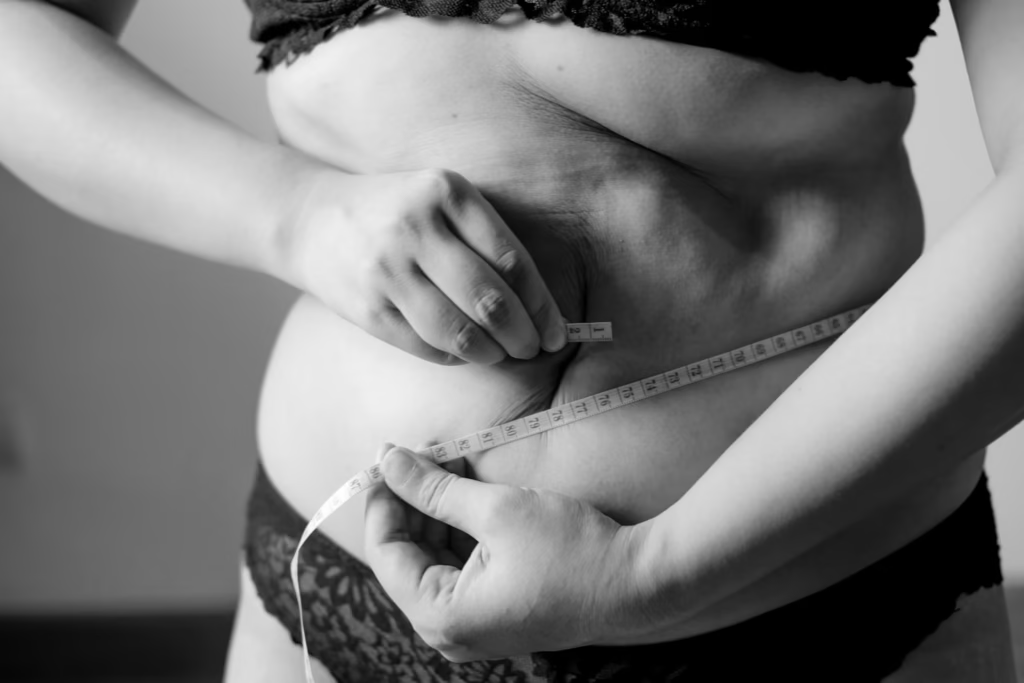
- Waist circumference measurement: Men should aim for <94 cm (37 inches), women <80 cm (31.5 inches)
- Waist-to-hip ratio
- Body fat percentage (DEXA scans, bioelectrical impedance)
- Skinfold thickness measurements
Health Risks Associated with BMI Categories
Understanding your BMI chart kg position helps identify potential health outcomes:
Underweight (BMI <18.5)
- Malnutrition and nutrient deficiencies
- Weakened immune system
- Osteoporosis and bone fractures
- Anemia and fertility issues
Overweight (BMI 25-29.9)
- Increased risk of hypertension
- Type 2 diabetes development
- Cardiovascular disease
- Joint problems and sleep apnea
Obesity (BMI 30+)
- Heart disease and stroke
- Certain cancers (colon, breast, endometrial)
- Severe sleep apnea
- Metabolic syndrome
- Reduced life expectancy
Clinical Insight: Research shows that maintaining a 3-5% weight loss can significantly improve blood glucose and triglyceride levels, while 5-10% loss reduces blood pressure and improves cholesterol
.
2026 BMI Trends and Global Statistics
Latest WHO data reveals critical trends:
- 2.5 billion adults were overweight in 2022
- 890 million lived with obesity globally
- Childhood obesity has quadrupled since 1990
- By 2025, obesity-related healthcare costs could reach $1.2 trillion annually
These statistics underscore why regular BMI monitoring using standardized kg measurements remains essential for public health.
Frequently Asked Questions (FAQ)
What is a normal BMI in kg?
A normal, healthy BMI ranges from 18.5 to 24.9 kg/m² for most adults
.
How do I convert pounds to kg for BMI?
Divide pounds by 2.205. For example, 150 lbs ÷ 2.205 = 68 kg.
Is BMI different for men and women?
No, the BMI chart kg calculation is identical for both sexes. However, women typically have higher body fat percentages at the same BMI
.
What BMI is considered obese in kg?
Obesity begins at BMI 30 kg/m², with severe obesity (Class III) at 40+
.
Can I use BMI if I’m muscular?
Athletes should use alternative measures like body fat percentage or waist circumference, as muscle increases weight without indicating poor health
.
Conclusion: Using Your BMI Chart KG Results
The BMI chart kg remains the most accessible tool for initial weight assessment globally. While imperfect, it provides a standardized starting point for health conversations with your provider.
Next Steps:
- Calculate your current BMI using the metric formula above
- Check your category against the 2026 WHO standards
- Measure your waist circumference for additional context
- Consult a healthcare provider for personalized interpretation, especially if your BMI falls outside the healthy 18.5-24.9 range
Remember: BMI is a screening tool, not a diagnostic measure. Combine it with other health indicators for a complete picture of your wellbeing.

A health content specialist with hands-on experience in BMI Calculator Pro tools, focused on accurate body measurements, BMI insights, and easy-to-understand health guidance for everyday users.



Pingback: Weight BMI Chart 2026: Are You Actually Healthy? - BMI Calculator Pro